
Chelation Technology
Pixon Chemie is a specialist chemistry company providing chelant solutions for modern agriculture.
Our advanced chelation technology is designed to improve micronutrient delivery to plants by helping nutrients remain stable in different growing conditions.
Our comprehensive chelant portfolio supports better nutrient delivery, reduced waste and improved fertiliser efficiency, backed by decades of innovation and global expertise.
What is Chelation?
Chelation is the process of binding metal nutrients to organic molecules, which helps to protect nutrients such as iron, zinc, copper and manganese.
It helps stop nutrients from reacting with soil and becoming unavailable by reducing precipitation and soil fixation.
By supporting nutrient availability at both root and leaf level, chelation helps plants access the nutrients they need more efficiently.
Synthetic Chelant Portfolio
Synthetic chelates are designed for reliable performance and controlled nutrient delivery. Each chelate has a different pH range, stability level and best use case, offering a range of solutions for specific agricultural needs and applications.
Some chelates are better for foliar feeding, while others are better for alkaline soils or fertigation. Because chelant selection depends on soil, crop and application method, Pixon Chemie can help identify the right chelation technology for efficient performance.
EDTA Chelates
EDTA is a common, industry-standard chelating agent that works best in acidic to neutral conditions.
It can be used for foliar nutrition, hydroponics and starter fertilisers. As a widely used chelation option, EDTA is available with different metals, including iron, zinc, copper, manganese, calcium and magnesium.
EDTA chelates are a dependable option for general micronutrient delivery where pH conditions are suitable.
EDDHA Chelates
EDDHA is a strong choice for alkaline soils, mainly used for iron chelation. Performing well in high-pH and calcareous soils, it helps prevent or correct iron deficiency, which is often seen as chlorosis or yellowing leaves.
This makes it well suited to challenging alkaline soil conditions, offering longer-lasting iron availability compared with lower-stability chelates.
EDDHSA Chelates
EDDHSA is a specialist option for very high-pH environments, designed specifically for extremely alkaline conditions.
It provides strong stability in high-pH conditions and helps protect iron availability, making it suited to difficult soil conditions where other iron chelates may be less effective.
As a high-performance chelate, it is useful for crops where iron availability is critical, and soil pH is a major challenge.
HEEDTA Chelates
HEEDTA can offer improved stability compared with EDTA in certain conditions. HEEDTA is most useful where reduced leaching is needed, working well in acidic to neutral pH ranges due to its strong pH-stability.
Positioned as a practical middle-ground between standard EDTA and more specialist chelates, it can be used as part of a wider micronutrient programme.
Biodegradable Synthetic Chelates
Biodegradable chelates represent the more sustainable side of synthetic chelation. These chelates are designed to balance performance with environmental responsibility, making them useful for customers looking for more sustainable fertiliser ingredients.
Because they can break down more readily than traditional synthetic chelates, biodegradable solutions contribute towards sustainable agriculture and eco-friendly micronutrients.
IDHA Chelates
IDHA is a biodegradable chelating agent, most suitable for acidic to neutral growing conditions.
It can be used with nutrients such as iron, zinc, copper and manganese, working to support more environmentally conscious nutrient delivery.
As a sustainable alternative for modern fertiliser formulations, IDHA is a key biodegradable chelant option.
GLDA Chelates
GLDA is based on renewable plant-derived raw materials, offering a wide pH range compared with some other biodegradable options.
Designed to be readily biodegradable, GLDA can be positioned as a strong choice for sustainable formulations that look to prioritise performance, safety and environmental impact.
MGDA Chelates
MGDA is another chelant with a strong environmental profile, known for its good biodegradability and low overall environmental impact.
As it can work across a wider pH range, it is relevant for formulations where environmental credentials are important.
MGDA chelants form part of the move towards cleaner, more sustainable chelation technology.
Natural Chelation Technology
Natural chelates use naturally derived compounds to support nutrient availability and can be useful in organic, biostimulant or natural crop nutrition products.
As a natural alternative to synthetic chelates, they may offer additional plant benefits beyond nutrient delivery. Natural chelates are widely used in agriculture and organic-compatible micronutrient solutions.
Amino Acid Chelates
Amino acid chelates are plant-friendly compounds that can bind with nutrients and help support plant uptake.
Because of their low molecular weight, they are useful for foliar applications and may also provide biostimulant benefits.
Amino acid chelates are available in different concentrations and can be used with several micronutrients. They’re a natural, crop-friendly option for efficient nutrient delivery.
Gluconate Chelates
Gluconate chelates are designed for strong solubility and bioavailability. They can support fast and efficient nutrient uptake, and are available with nutrients such as calcium, magnesium, manganese, copper and iron.
Their strong solubility and bioavailability make them suitable for higher-grade or specialist formulations.
Citrate Chelates
Citrate chelates are natural and plant-compatible, as citrates are involved in plant metabolic processes.
They can support rapid plant uptake and movement of nutrients, positioning them as a natural option for efficient nutrient transport.
They can also help with pH buffering, particularly where the focus is on plant compatibility and natural nutrient movement.
Lignosulfonate Complexes
Lignosulfonates are a cost-effective natural complexing option, helping to bind and carry nutrients.
Lignosulfonates can provide natural UV protection and may also offer soil-conditioning benefits, making them a practical, cost-effective nutrient complex for agricultural formulations.
pH Stability Comparison
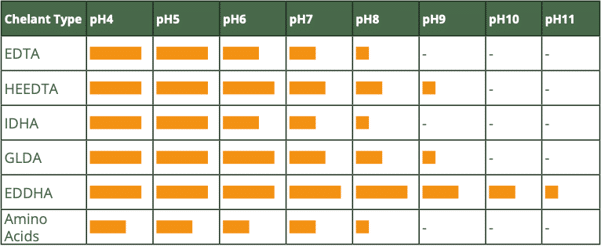
Choosing the right chelate matters because different chelates perform differently depending on pH.
EDTA works better in lower to neutral pH conditions, whereas EDDHA and EDDHSA are better suited to alkaline soils.
Both amino acids and biodegradable chelates have their own useful pH windows for effective performance. Soil pH should be a key factor when choosing the right chelate for efficient performance.
Application Guidelines
Application rates and methods matter.
Chelates can be applied through soil application, foliar spray, fertigation, hydroponics or seed treatment. The specific application rate depends on whether the product is being used for prevention, correction or severe deficiency.
Soil application is commonly used when nutrients need to be delivered to the root zone, especially where soil conditions are limiting availability. Foliar application delivers nutrients directly through the leaves and can be useful when a faster plant response is needed.
Fertigation is used when chelated nutrients are applied through irrigation systems, supporting more even nutrient distribution. Hydroponic systems also require highly soluble and stable chelates because nutrients are delivered directly through water.
For prevention, application rates are usually lower because they are designed to maintain good nutrient availability before visible symptoms appear. Correction rates are used when a deficiency has already been identified and the crop needs additional support. Severe deficiency rates are higher and should be used carefully, ideally with technical or agronomic guidance.
Selection Guide by Application
Chelant selection should be based on the conditions the nutrient needs to perform in. One of the most important factors is soil pH, as some chelates lose stability outside certain pH ranges.
EDTA, amino acids and GLDA are suitable in acidic to mildly acidic conditions. EDTA, IDHA, GLDA and HEEDTA are reliable in neutral soil conditions. EDDHA is more stable at higher pH levels in alkaline soils and premium EDDHA or EDDHSA can help keep iron available to the crop in very alkaline soils.
Different chelates are better suited to different application methods.
EDTA, IDHA and amino acids are useful for foliar feeding because they support uptake through the leaf surface. A wide range of chelants can be suitable for fertigation, provided they are soluble and compatible with the system. EDDHA and EDTA are useful for soil injection depending on pH and nutrient requirement. EDTA, IDHA and HEEDTA can be suitable for hydroponics because solubility and nutrient stability are especially important in water-based systems. Amino acid chelates are useful for seed treatments because of compatibility with plant development.
Crop types have different nutrient requirements, so this should also guide selection. Fruit trees and ornamental crops may benefit from chelates with longer-lasting iron availability in high-pH soils, whereas organic or natural crop nutrition programmes may be better suited to amino acids, gluconates or other natural chelation technologies.
Innovation in Chelation
The evolution of chelation technology is leading to more efficient, targeted and environmentally responsible products. As new technologies are developed to support modern agricultural demands, sustainable chelation is becoming increasingly important for growers and formulators seeking products with lower environmental impact.
Biodegradable chelates such as IDHA, GLDA and MGDA provide alternatives to conventional synthetic options, with plant-derived chelation technologies supporting more sustainable fertiliser formulations.
Different natural chelation options are available depending on the application, including amino acids, gluconates, citrates and lignosulfonates.
Amino acid chelates can combine nutrient delivery with biostimulant-style benefits. Gluconate and citrate chelates support nutrient bioavailability and plant compatibility, whereas lignosulfonate complexes can provide cost-effective nutrient complexing with added natural UV protection.
Innovation in chelation also includes custom chelant blends that are designed for specific pH ranges, crop needs or formulation requirements. Chelation is more than a technical ingredient; it can play a key role in improving nutrient efficiency, crop performance and sustainable agriculture.
Compatibility & Formulation
Compatibility is important because chelates are often used alongside other fertiliser ingredients, pesticides or crop inputs. They need to be mixed, formulated and handled correctly to perform properly.
A chelate may be compatible with one ingredient but less stable with another, which is why tank mix testing is recommended before combining products at scale.
pH, concentration and water quality all affect the stability of a chelate. Performance can be affected by water quality, especially if the water has high hardness, high pH or high levels of dissolved minerals. The pH of the final solution should be checked because some chelates perform better within specific ranges.
The order in which ingredients are dissolved can affect the stability of the final mix. Some combinations, such as calcium and phosphates, can be more challenging and may require extra testing.
Although chelates may be used with NPK fertilisers, calcium products, phosphates, pesticides and other chelates, compatibility should not be assumed. Poor compatibility can lead to precipitation, reduced nutrient availability or blocked application equipment.
Concentration, pH, storage conditions and shelf life should be considered by formulators when developing chelated products. Once a tank mix has been prepared, it is best to use it promptly rather than leaving it standing for long periods. Chelation performs best when the right formulation process is followed.
Quality Assurance
At Pixon Chemie, we have strict product testing and control measures. Our testing parameters include:
- Metal content (ICP-OES)
- Chelation degree (>95%)
- pH stability verification
- Solubility testing
- Microbiological analysis
With batch-to-batch consistency and complete traceability, our products are designed to deliver reliable, technically controlled performance.
Storage & Handling
Storage conditions can have a large effect on shelf life and performance. Chelates should usually be stored in sealed packaging, protected from heat, humidity and direct sunlight.
Standard PPE and safe handling processes are followed, with technical data sheets or safety data sheets being available if relevant.
Why Pixon Chemie?
Our chelants are developed to high purity standards with consistent quality control. Our advanced production technology and global manufacturing capabilities define our breadth of chelant range and deep formulation expertise.
Pixon Chemie’s focus on innovation is supported by sustainable solutions and ongoing R&D investment. Our team continues to innovate by developing technically advanced solutions for modern agricultural requirements.
Our global support includes technical expertise, application guidance, formulation assistance and help with regulatory compliance.
Work with Pixon Chemie
By partnering with Pixon Chemie, you’ll gain access to technologically advanced chelation solutions designed to improve micronutrient delivery across a wide range of growing conditions.
Contact Pixon Chemie Today
London HQ, 16 Berkeley Street, London, W1J 8DZ